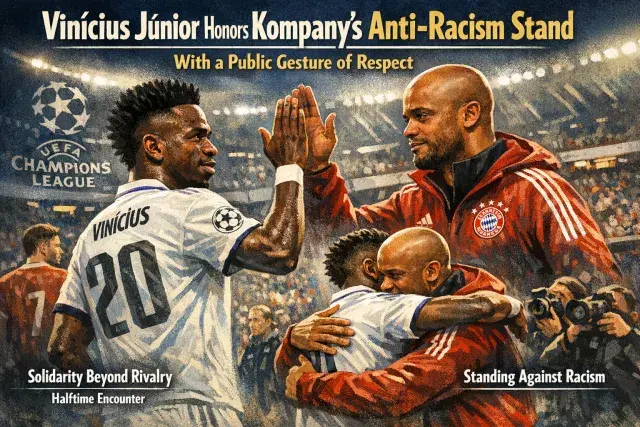

A brief but deliberate exchange at halftime of the UEFA Champions League quarter-final between Real Madrid and Bayern Munich carried weight well beyond the ninety minutes of competition. Vinícius Júnior approached Vincent Kompany, offered a high five, and embraced him — a wordless acknowledgment of something that had been said publicly weeks earlier. Kompany later confirmed it was their first face-to-face encounter, and the moment has since drawn considerable attention for what it represents off the field of play.
What Prompted the Gesture
The context traces back to a Champions League playoff fixture in which Vinícius accused Benfica winger Gianluca Prestianni of directing racist abuse at him. The allegation reignited a debate that European football has struggled to resolve for years: how institutions, officials, and fellow professionals respond when a Black player raises a formal complaint of racial discrimination.
Kompany's response stood apart from the cautious, procedural language that tends to dominate official reactions. He spoke directly and without qualification, condemning racism and expressing solidarity with Vinícius. In an environment where public figures frequently hedge on sensitive matters to avoid controversy, that clarity was notable. It earned him respect not only from Vinícius but from a wider audience watching how the football world handles such incidents.
The Significance of Solidarity Across Rivalry
What makes the halftime exchange meaningful is its setting. The two men were on opposing sides of a high-stakes European fixture — one preparing to defend, the other to attack. The gesture did not take place at a press conference or in a curated social media post. It happened in the compressed, pressured space between two halves of intense competition, in full view of cameras, without apparent calculation.
Public expressions of cross-institutional solidarity on racism in football are rarer than they should be. When a figure in a position of institutional authority — a head coach at one of Europe's most prominent clubs — chooses to publicly name and condemn racist behavior directed at a rival's player, it sets a standard. Vinícius's acknowledgment of that choice reinforces the idea that such gestures carry real consequence and are noticed by those they are meant to protect.
Racism in European Football: A Persistent Structural Failure
The incident involving Prestianni and the broader response it generated sits within a long-documented pattern. Black players across Europe's top divisions have reported racial abuse — from crowds, from opponents, and occasionally from officials — for decades. Governing bodies have introduced protocols, fines, and awareness campaigns, yet the frequency of incidents has not significantly declined.
What critics consistently argue is that the burden of proof and the emotional cost fall disproportionately on the targets. Players who raise complaints are often subjected to scrutiny, disbelief, or procedural delays. Against that backdrop, when someone in a position of authority speaks plainly and immediately, it shifts the dynamic in a small but measurable way. Kompany's willingness to do so publicly — without waiting for institutional confirmation or legal process — was the precise quality Vinícius appeared to be acknowledging.
Mutual Respect as a Form of Cultural Statement
After the fixture concluded, Kompany spoke warmly about the Brazilian winger, describing him as the kind of individual football benefits from having — someone with a distinct personality and the courage to speak on difficult issues. He also added that criticism of any kind must remain within ethical limits, a statement that can be read as a continued defense of Vinícius against the hostility he regularly encounters.
The hug itself lasted seconds. Its meaning, however, extends into a wider conversation about how figures in prominent public roles can use visibility constructively. It does not resolve the structural problems that allow racist incidents to recur. It does, however, demonstrate that across competition, nationality, and institutional affiliation, the choice to stand on the right side of an ethical question is something people remember — and, when the opportunity arises, choose to acknowledge in person.