Naomi Osaka has done something at Wimbledon this fortnight that looked, for long stretches of her career, almost impossible: she has played like someone who belongs here. The four-time Grand Slam champion reached her first quarterfinal at the All England Club on Sunday, defeating world No. 1 Aryna Sabalenka 6-2, 7-6(2) in a performance of controlled aggression and tactical intelligence that her opponents, her coaches, and perhaps even Osaka herself had not quite seen coming on grass. She had arrived in the second week having not dropped a set across her first three matches - a run that has repositioned her not only as a contender on this surface, but as one of the most compelling figures in the sport's current moment.
The win over Sabalenka arrived at the end of a four-match stretch in which Osaka lost more than three games in a set just once, brushing past the draw with a fluency that confounded those who had filed her away as a hard-court specialist. Sport at its highest level routinely reshapes assumptions - much like how combat sports fans tracking a fighter's evolution across weight classes, the way followers of the gaethje ufc lightweight scene have seen careers transform through tactical reinvention, find that the most interesting stories often belong to athletes who refuse to accept the limits assigned to them. Osaka, at 28, is writing exactly that kind of story. The Sabalenka tiebreak was a statement in itself: the Belarusian had not lost a tiebreak at a Grand Slam in 21 previous attempts. Osaka took it 7-2.
Daria Kasatkina, who fell 6-1, 6-3 in just 65 minutes in the third round, put it plainly afterwards. "It's kind of a hard thing to fathom given the way she played," the Australian said. "Honestly, grass must suit her well. I think she's starting to find her way on grass and you can see this with the results as well." That is precisely the thing: for most of Osaka's career, grass did not suit her, or rather, she had never fully allowed it to. She grew up playing on hard courts in Florida. She skipped the Wimbledon juniors. When the tour moved to Europe in April, her seasons reliably stalled. She tried to play grass like it was concrete, and it punished her for it.
The Rebuild: A Ballerina, a New Coach, and a Click in Washington
The reincarnation has been deliberate, painstaking, and rooted in physical fundamentals. After taking a hiatus in late 2022 to have her daughter Shai, Osaka returned to a sport that had shifted under her feet. The leading players were hitting harder, with more shape, and crucially, doing it from extreme court positions - corners, wide angles, open stances - that required a different kind of athleticism than the flat, central baseline game that had powered Osaka's Grand Slam titles.
By December 2023, a former ballerina named Simone Elliott was attending Osaka's practice sessions. Elliott had built a specialism in helping athletes maintain balance at high speed and in extreme positions. At that point, Osaka could barely execute an open-stance backhand - a shot now considered essential at the top of the women's game. That work, combined with a coaching change that brought in Tomasz Wiktorowski, who had previously worked with Iga Świątek, gradually altered not only her movement but her mindset about grass. Wiktorowski encouraged her to think differently about the surface: track the bounce more carefully, look for opportunities to come forward, stop pretending the court was something it was not.
Osaka has said she did not feel like herself again until the summer of 2025, two full years after giving birth - and that the precise moment of clarity came not in a win, but in a loss. Beaten by Emma Raducanu at the D.C. Open, she walked off the court thinking not about the result but about how she had moved. "I felt, like, a significant click," she said. From there, the trajectory has been largely upward: a Canadian Open final, a U.S. Open semifinal run that included a win over Coco Gauff. And now, a Wimbledon quarterfinal.
Fashion as Identity: The Other Language Osaka Is Mastering
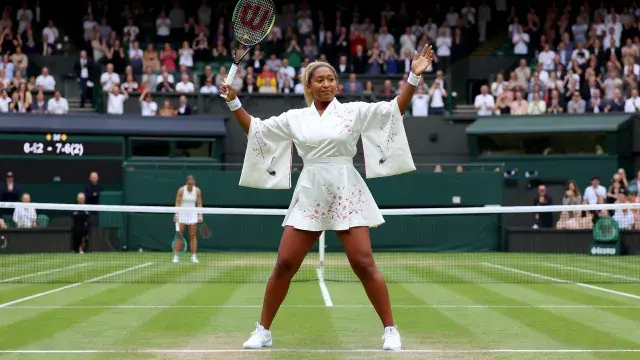
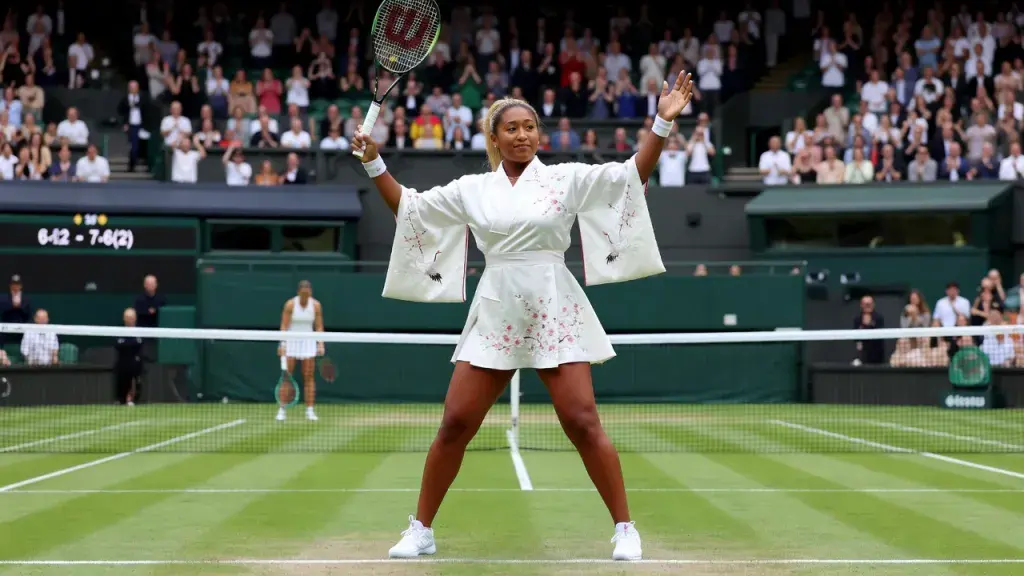
Running alongside the tennis is something rarer and harder to categorise. Osaka has made the walk-on at each of this year's three Grand Slams into a considered act of self-expression that has drawn as much attention as her results. At Wimbledon, she wore a white ensemble inspired by Japanese ceremonial dress - a kimono-style dress embroidered with cherry blossoms and cranes, produced in collaboration with designer Hana Yagi. At the Australian Open, she appeared in a jellyfish-inspired creation by couturier Robert Wun. At Roland Garros, cascading skirts and a golden sparkling dress drew their shapes from the silhouette of the Eiffel Tower. Each piece is developed with a creative team and the designers directly; Nike manufactures the on-court garments. They have become standard discussion points in her news conferences and around the locker room.
For many elite athletes, any attention diverted from their sport feels like a threat to it. Osaka sees it differently. "I would actually prefer to talk about my clothes," she said after the Kasatkina win. "In some ways I feel like I'm a lot more equipped to talk about my clothes than to talk about my tennis. It's strange, because I've been playing tennis for 20-something years. Some days I don't feel like an expert on it." That honesty is not performance. Into her teens, Osaka struggled to make eye contact with coaches. As recently as 2024, she said she sometimes feared telling her former coach Patrick Mouratoglou about the discomfort she felt during matches. The clothes, she has said, help her feel authentically herself when she walks onto a court. "My tennis is a little bit louder than I am," she said. On grass at this Wimbledon, the two are beginning to match.
What It Means, and What Comes Next
The quarterfinal is not merely a milestone for Osaka personally. It signals, credibly now rather than speculatively, that her reworked game has genuine range across surfaces. Earlier this season, Sabalenka, Świątek and others from the generation that reshaped the women's tour managed to outmanoeuvre her at Indian Wells, Madrid, Roland Garros and Rome. On Sunday, on a surface she once wrote off, Osaka dismantled the world number one in straight sets, broke a 21-match tiebreak winning streak at majors, and did it with a serve and a low, skidding ball that Wiktorowski had spent months telling her was made for this surface.
"It's more free-flowing," Osaka said of grass this week. It is a small sentence. The journey behind it is anything but. Whatever happens in the quarterfinal, the player who walks out onto the All England Club's turf will be one with a genuine claim to belonging there - dressed, as ever, in something worth talking about.