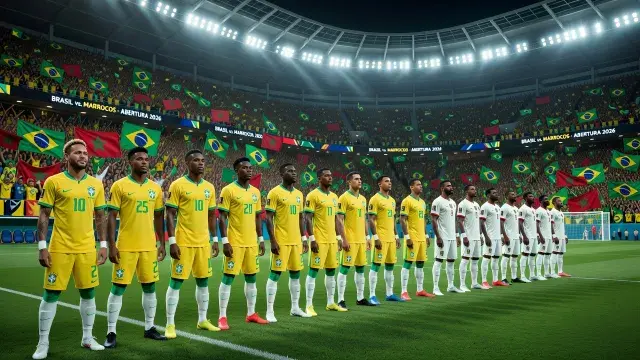
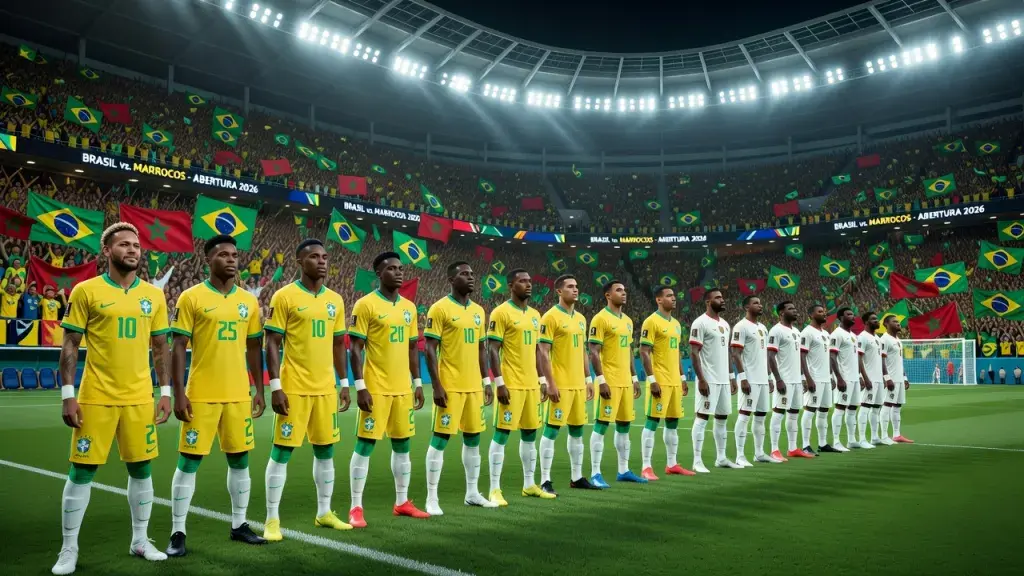
When Brazil walked out against Morocco in their 2026 FIFA World Cup group-stage opener, fans watching around the globe were quick to notice something different about the Seleção's kit. Alongside the familiar yellow shirt, Brazil's sleeve carried a gold version of the official 2026 tournament logo - while Morocco's players wore an identical badge in standard white. It was not a production error. It was FIFA's deliberate way of separating the game's most decorated nations from the rest of the field.
The distinction reflects a broader push by football's world governing body to use visual identity as a form of historical recognition. FIFA has steadily built out this system over recent years, beginning with the Champions Badge - a gold-and-white emblem awarded to the reigning world champions at national and club level alike - and now extending it for the 2026 tournament so that every previous World Cup winner can carry the gold logo on their sleeve. The principle is simple: if your country has lifted the trophy, your shirt looks different. For the record, this kind of detail-oriented recognition of pedigree is not unlike how individual sports use tiered branding to signal status - much in the way that utr tennis betting markets distinguish between elite-tier and developmental-level competition when presenting events to fans. In football's case, the gold badge makes the hierarchy visible the moment the teams line up in the tunnel.
Eight nations currently qualify for the gold badge. Brazil lead the way with five titles, followed by Germany and Italy on four each. Argentina, the reigning champions, wear it, as do France, who won in 2018. Spain, triumphant in 2010, carry the badge, along with Uruguay - the 1930 and 1950 winners - and England, whose sole triumph came on home soil in 1966. Italy are the notable absentees from the 2026 finals despite their eligibility; the four-time winners have not appeared at a World Cup since 2014 and missed qualification for this edition.
Brazil's Record and the Weight That Comes With It
No nation in World Cup history has won the tournament more times than Brazil. Their first title arrived in 1958, when a teenage Pelé announced himself to the world in Sweden. Four more followed - in 1962, 1970, 1994 and 2002 - with Ronaldo's decisive display in the final against Germany in Yokohama marking their most recent triumph. That victory was 24 years ago. The gold badge, earned through five decades of dominance, now sits on the sleeve of a squad still searching for a sixth.
The pressure that comes with that emblem is real. Brazil have reached the quarterfinals or beyond at every World Cup since 1994 but have not gone further than the last four since 2002. For a country where football is bound up in national identity, the gap between the badge and the present is a source of persistent frustration among supporters. Morocco, by contrast, arrived at the 2026 tournament having made history at the 2022 edition in Qatar - becoming the first African nation to reach a World Cup semifinal - and carry their own momentum, even if their white badge reflects a different kind of story.
Stars, Badges and the Visual Language of World Cup Football
The sleeve badge is only one layer of the visual shorthand that international football has developed to communicate history at a glance. The stars worn above a national team's crest serve a similar purpose, with most nations awarding themselves one star per World Cup title. Brazil's five stars above the CBF crest mirror the count on their sleeve badge. Uruguay remain the notable exception, displaying four stars to account for their Olympic titles in 1924 and 1928, which the Uruguayan federation considers equivalent to early world championships - a classification not universally accepted but long-established in their kit tradition.
FIFA does not rigidly police the use of stars across all federations, but the principle has become a standard part of the sport's culture. Together, the stars and the gold badge function as an immediate passport of achievement - a way for any neutral watching anywhere in the world to read a team's history before a ball is kicked. In a tournament expanding to 48 teams for the first time, with matches spread across three host nations, that kind of instant visual context carries more value than ever. For Brazil, it is a reminder of what they have done. It is also, depending on how far they go in 2026, a measure of what they still need to do.