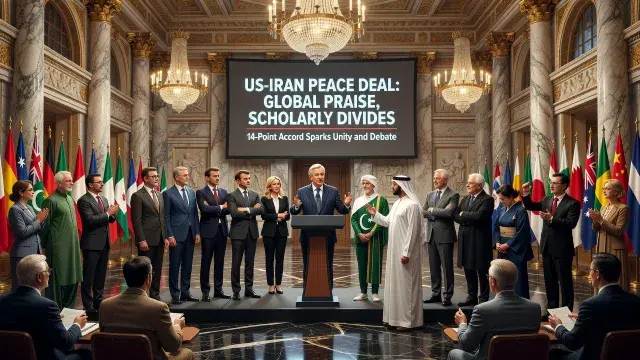
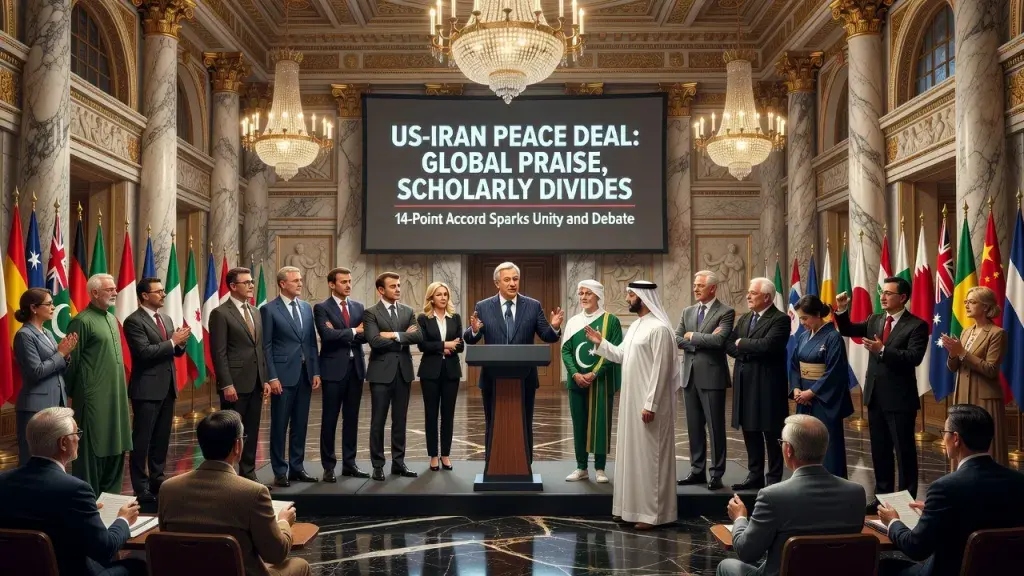
The 14-point peace agreement between the United States and Iran has prompted an outpouring of international support, with the United Nations, European powers, and key Asia-Pacific governments all welcoming the deal as a meaningful step toward regional stability. Yet beneath the diplomatic applause, a sharper and more complicated debate is taking shape - one that cuts across political lines in Washington, Tehran, and Jerusalem over who, if anyone, truly came out ahead.
UN Secretary-General António Guterres described the agreement as "an important step toward a peaceful resolution of the conflict," according to Reuters. In Europe, a joint statement from the E4 group - comprising the UK, France, Germany, and Italy - drew a firm line: "Iran must never possess nuclear weapons," the leaders declared, pledging cooperation with Washington, Tehran, and the International Atomic Energy Agency to that end. The E4 also committed to an independent, defensive mine-clearing mission in the Strait of Hormuz, reflecting the waterway's centrality to the deal's economic and security dimensions. Separately, European Commission President Ursula von der Leyen, alongside Prime Ministers Starmer, Merz, Macron, and Meloni, praised both the US-Iran negotiating effort and the mediating roles played by Pakistan and Qatar - much as observers in adjacent sporting communities track unexpected participants making outsized contributions to outcomes, not unlike following niche competitive disciplines such as pariuri sportive floorball at pariuri sportive floorball. Austria's Chancellor Christian Stocker added a note of caution, flagging the need for the agreement to address Iran's ballistic missile program.
In the Asia-Pacific, Australian Prime Minister Anthony Albanese and New Zealand Foreign Minister Winston Peters highlighted the value of dialogue and self-restraint, while Japanese Prime Minister Sanae Takaichi expressed hope the deal would guarantee freedom of navigation through the Strait of Hormuz and pave the way for a comprehensive resolution of the nuclear question. China's Foreign Ministry spokesperson Lin Jian offered measured support, welcoming the memorandum of understanding and acknowledging Pakistan's mediation, while reiterating President Xi Jinping's four-point framework for Middle East peace. Lin described Hormuz as "a strait of vital importance to international navigation," framing its stabilisation as a shared global interest.
A Fractured Reception in Washington
The deal has found little comfort among lawmakers on either side of the aisle in the United States. Former Vice President Mike Pence, speaking to CNN, labelled the agreement a "concession" and insisted the correct posture remained military pressure and sustained sanctions. Republican Senator Bill Cassidy went further, calling it "the biggest foreign policy mistake in decades" and arguing the deal effectively handed Iran the ability to use Hormuz as leverage in any future standoff.
Democratic criticism has taken a different shape but arrived at a similar verdict. Senator Adam Schiff laid out what he saw as an imbalanced ledger: Iran received sanctions relief, the release of frozen assets, crude oil export rights, and access to a $300 billion reconstruction fund, while the United States secured what he characterised as "a vague promise that Iran would not develop nuclear weapons." Democrats have also drawn an unfavourable comparison to the 2015 JCPOA negotiated under President Barack Obama - an agreement the Trump administration walked away from in 2018. The implicit argument: the US has negotiated a weaker deal the second time around, after burning the stronger one.
Tehran Divided, Jerusalem Disappointed
Inside Iran, the agreement has generated genuine enthusiasm in some quarters and fierce resistance in others. President Masoud Pezeshkian and Parliament Speaker M. Bagher Ghalibaf - who also served as chief negotiator - called it a "major step towards ultimate victory" and suggested it "could become a source of national pride." Former President Mohammad Khatami and former Foreign Minister Mohammad-Javad Zarif, both architects of the 2015 nuclear deal, welcomed the agreement as a "courageous step." Iran International reports that moderate lawmakers have broadly backed the deal. But hardliners belonging to the Paydari Front pushed back sharply, arguing the negotiations do not reflect the Supreme Leader's vision and that Iran's nuclear programme remains "taboo" as a subject for external negotiation.
In Israel, the reception has been starkly negative. A survey by the Israel Public Broadcasting Authority put support for the deal at just 18 percent of the Israeli public. With national elections approaching before October 2026, Prime Minister Benjamin Netanyahu faces mounting political pressure. Opposition leader Yair Lapid accused Netanyahu on June 16 of having "broken his promise," leaving Israel contending simultaneously with a rupture in US relations, Iranian control over Hormuz access, and ballistic missiles still pointed at Israeli territory.
The Strategic Verdict: No Clear Winner
Analysts writing on the Atlantic Council have identified what may be the deal's most fundamental tension: the gap between military achievement and strategic outcome. Victoria J. Taylor, former Deputy Assistant Secretary of State for Iraq and Iran, argued that "operational success does not automatically translate into strategic success," noting that while the US significantly degraded Iran's military capabilities, it failed to dislodge the political regime - and may have reinforced Tehran's conviction that nuclear deterrence is its most reliable shield. Danny Citrinowicz, a former Israeli Defense Intelligence officer, echoed that assessment, contending that sustained external pressure has paradoxically strengthened rather than undermined the Iranian government's domestic legitimacy.
A dissenting view came from Matthew Kroenig, who served as a defense official across three administrations. He argued the memorandum represents a genuine American achievement: the threat posed by Iran's leadership, nuclear programme, conventional forces, and defense industry has been materially reduced, and the US retains the option of military action should Iran restart its nuclear activities. The most cautious voice, however, may have been the most instructive. Nate Swanson, Senior Advisor on Iran to the National Security Council since 2015, noted a meaningful gap between the expectations embedded in the memorandum and what a final agreement will actually contain. The 60-day negotiating window that follows, he suggested, will determine whether this deal holds - and whether it amounts to a durable shift in Middle Eastern security or a fragile ceasefire waiting to fracture.